

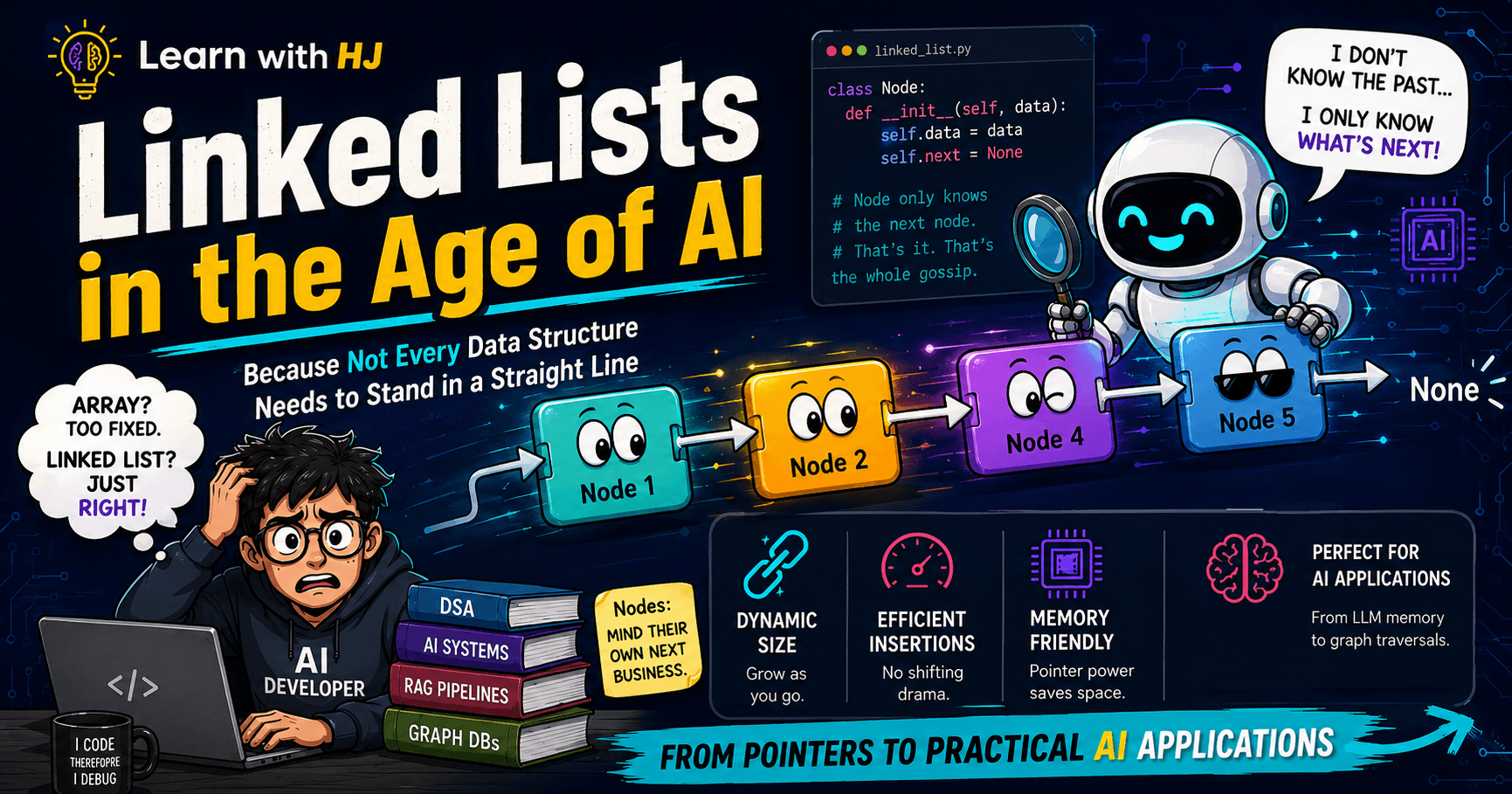
🔗 Linked Lists in the Age of AI
Because Not Every Data Structure Needs to Stand in a Straight Line
Hey there! 👋 I'm Hardeep Jethwani (HJ), your resident cloud aficionado and code maestro, proudly navigating the ever-changing seas of AWS Cloud and Full Stack Development for ~5 glorious years and counting. ☁️💻
Currently, I'm orchestrating the tech symphony as part of Team HSBC Bank, where I'm on a mission to enhance the banking experience through the magic of technology. 🚀💼
In my past life at Capgemini, I led exciting adventures like migrating critical applications to the cloud (18 and counting!). I had databases waltzing into the AWS Cloud, sprinkling a bit of containerization magic along the way. AWS managed services like RDS, Lambda, ECS, and friends? They were my trusty sidekicks. 🎩🔧
When not automating deployments with CI/CD finesse (think AWS CodePipeline, CodeBuild, and CodeDeploy), you might find me designing infrastructure like a digital architect using AWS CloudFormation. Security is my jam – I've got WAF, Security Groups, MFA, Cognito, and even a secret club in private subnets to keep things safe. 🔒💂♂️
On top of all that, I'm on a mission to reduce carbon footprints because, why not? HSBC's commitment to sustainability is my heart and soul. We're going for NET ZERO carbon footprint, and I'm leading the charge, one container at a time! 🌍🌱
And yes, the fun doesn't stop at work. In my past life at Tata Consultancy Services, I co-created a multi-tier Point of Sale application with a global footprint, touching the lives of billions. My automation tools were so efficient that even Father Time was left scratching his head. ⏳💡
If you're in need of a cloud-savvy comedian or a code deployment magician, look no further. Let's chat about tech, swap automation tales, or share some coding humor over a virtual coffee. Oh, and don't worry; I promise not to write code in my sleep (well, most of the time). Cheers to cloud adventures! ☕🚀
A beginner-friendly and humorous guide to linked lists, nodes, references, operations, time complexity, cycle detection, reversal, and practical AI use cases with Python.
😂 Everyone Knows Only the Next Person
Imagine a queue outside a famous food stall.
The first person knows who is standing behind them. That person knows the next person, and so on.
But if you ask the first person:
“Who is standing at position 927?”
They cannot instantly point to that person. They must ask:
“Who is next?”
Then that person asks the same question, until the stall has closed and your program has finally reached node number 927.
Congratulations. You have understood a linked list. 😄
A linked list is a collection of elements called nodes. Each node normally stores:
Some data
A reference to another node

The first node is the head. The final node usually points to None, which is Python’s way of saying:
“Boss, there is nobody after me.”
🤖 Why Linked Lists Still Matter in AI
Modern AI is dominated by tensors, arrays, GPUs, embeddings, and matrices. Those structures benefit from compact, contiguous memory.
So are linked lists useless in AI?
Not at all.
Linked structures help us understand or build:
Dynamic queues
Agent execution traces
Undo and redo histories
Streaming pipelines
LRU caches
Graph adjacency lists
Sparse and irregular relationships
Workflow chains
Memory allocators
Event-processing systems
They also teach important ideas:
References
Object identity
Dynamic memory
Two-pointer algorithms
Time complexity
Data-structure trade-offs
However, remember:
Linked lists are not automatically faster just because insertion can be
O(1).
For dense numerical AI operations, Python lists, NumPy arrays, and tensors are generally better because they support fast indexing, compact storage, and hardware-friendly access.
Linked lists are most useful when relationships and dynamic updates matter more than random access.
🧱 What Is a Node?
A node stores a value and a link to the next node.
class Node:
    def __init__(self, value):
        self.value = value
        self.next = None
Create two nodes:
first = Node("AI")
second = Node("Python")

first.next = second
Now:

first.next does not copy the second node. It stores a reference to it.
That connects directly to memory management: nodes are separate objects joined through references.
📦 Building a Basic Singly Linked List
A singly linked list supports movement in one direction.
class Node:
    def __init__(self, value):
        self.value = value
        self.next = None


class SinglyLinkedList:
    def __init__(self):
        self.head = None
Initially:

Core terms:
Head: first node
Tail: final node
Traversal: visiting nodes one by one
Insertion: adding a node
Deletion: removing a node
Search: finding a value
Cycle: a path that eventually returns to a previous node
A cycle is the linked-list version of:
“We are going in circles.”
Except the computer means it literally.
🚶 Traversal
To display values, start at the head and follow next.
class SinglyLinkedList:
    def __init__(self):
        self.head = None

    def display(self):
        current = self.head

        while current is not None:
            print(current.value, end=" -> ")
            current = current.next

        print("None")
Example:
first = Node("AI")
second = Node("Python")
third = Node("RAG")

first.next = second
second.next = third

linked_list = SinglyLinkedList()
linked_list.head = first

linked_list.display()
Output:
AI -> Python -> RAG -> None
Complexity
Time:
O(n)
Extra space:
O(1)
Unlike arrays, linked lists do not provide direct indexed access. To reach node 500, we normally walk through nodes 0 to 499 first.
⚡ Insert at the Beginning

class SinglyLinkedList:
    def __init__(self):
        self.head = None

    def prepend(self, value):
        new_node = Node(value)
        new_node.next = self.head
        self.head = new_node
Before:

After prepending "DSA":

Time:
O(1)
Only two references change.
This remains constant whether the list contains five nodes or five million.
🏁 Insert at the End
Without a tail reference:
def append(self, value):
    new_node = Node(value)

    if self.head is None:
        self.head = new_node
        return

    current = self.head

    while current.next is not None:
        current = current.next

    current.next = new_node
Time:
O(n)
We must find the final node.
Improve it with a tail
class SinglyLinkedList:
    def __init__(self):
        self.head = None
        self.tail = None

    def append(self, value):
        new_node = Node(value)

        if self.head is None:
            self.head = new_node
            self.tail = new_node
            return

        self.tail.next = new_node
        self.tail = new_node
Now append is:
O(1)
Maintaining one extra reference saves repeated traversal.
🎯 Insert After a Value
def insert_after(self, target, value):
    current = self.head

    while current is not None:
        if current.value == target:
            new_node = Node(value)
            new_node.next = current.next
            current.next = new_node

            if self.tail is current:
                self.tail = new_node

            return True

        current = current.next

    return False
Searching for the target:
O(n)
The actual pointer update after finding it:
O(1)
Overall:
O(n)
So when somebody says:
“Linked-list insertion is always O(1),”
ask:
“Do we already have the node, or are we first searching the whole list?”
The insertion is fast. Finding the location may not be.
📍 Insert at a Position
def insert_at(self, index, value):
    if index < 0:
        raise IndexError("Index cannot be negative")

    if index == 0:
        self.prepend(value)
        return

    current = self.head
    current_index = 0

    while (
        current is not None
        and current_index < index - 1
    ):
        current = current.next
        current_index += 1

    if current is None:
        raise IndexError("Index out of range")

    new_node = Node(value)
    new_node.next = current.next
    current.next = new_node

    if new_node.next is None:
        self.tail = new_node
Time:
O(n)
The list must be traversed to the requested position.
🔎 Search for a Value
def contains(self, target):
    current = self.head

    while current is not None:
        if current.value == target:
            return True

        current = current.next

    return False
Best case:
O(1)
Worst and average case:
O(n)
Every node knows only the next node. Nobody has the complete attendance sheet.
🎲 Access by Index
def get(self, index):
    if index < 0:
        raise IndexError("Index cannot be negative")

    current = self.head
    current_index = 0

    while current is not None:
        if current_index == index:
            return current.value

        current = current.next
        current_index += 1

    raise IndexError("Index out of range")
Time:
O(n)
Array access is normally O(1). Linked-list indexed access is O(n).
This is one reason arrays dominate tensor and vector workloads. A GPU wants a predictable block of numbers, not a treasure hunt through Python objects.
🗑️ Delete the Head

def delete_first(self):
    if self.head is None:
        return None

    removed_value = self.head.value
    self.head = self.head.next

    if self.head is None:
        self.tail = None

    return removed_value
Time:
O(1)
We simply move the head reference.
🗑️ Delete the Tail
In a singly linked list, the tail does not know the previous node.
def delete_last(self):
    if self.head is None:
        return None

    if self.head.next is None:
        removed_value = self.head.value
        self.head = None
        self.tail = None
        return removed_value

    current = self.head

    while current.next.next is not None:
        current = current.next

    removed_value = current.next.value
    current.next = None
    self.tail = current

    return removed_value
Time:
O(n)
Even with a tail reference, we must find the second-last node.
This is where a doubly linked list becomes useful.
✂️ Delete a Specific Value
def delete_value(self, target):
    if self.head is None:
        return False

    if self.head.value == target:
        self.delete_first()
        return True

    current = self.head

    while current.next is not None:
        if current.next.value == target:
            node_to_remove = current.next
            current.next = node_to_remove.next

            if node_to_remove is self.tail:
                self.tail = current

            return True

        current = current.next

    return False
Time:
O(n)
The pointer update is constant time, but the search may visit the whole list.
📏 Length of the List
Traverse every time
def length(self):
    count = 0
    current = self.head

    while current is not None:
        count += 1
        current = current.next

    return count
Time:
O(n)
Maintain a size attribute
class SinglyLinkedList:
    def __init__(self):
        self.head = None
        self.tail = None
        self.size = 0

    def __len__(self):
        return self.size
Now length is:
O(1)
But every successful insertion and deletion must update size.
Forget one decrement and your linked list begins lying about its age.
🔄 Reverse a Linked List
Original:

Reversed:

Use three references:
def reverse(self):
    previous = None
    current = self.head

    self.tail = self.head

    while current is not None:
        next_node = current.next
        current.next = previous
        previous = current
        current = next_node

    self.head = previous
We must save next_node before changing current.next.
Otherwise we lose the rest of the list.
That is less “reverse the list” and more “accidentally delete the project roadmap.”
Time:
O(n)
Extra space:
O(1)
Recursive reversal
def reverse_recursive(self):
    def reverse_node(node):
        if node is None or node.next is None:
            return node

        new_head = reverse_node(node.next)

        node.next.next = node
        node.next = None

        return new_head

    self.tail = self.head
    self.head = reverse_node(self.head)
Time:
O(n)
Auxiliary space:
O(n)
because recursion creates call frames.
The iterative version is usually more memory-efficient.
🎯 Find the Middle Node

Use slow and fast pointers:
def find_middle(self):
    slow = self.head
    fast = self.head

    while fast is not None and fast.next is not None:
        slow = slow.next
        fast = fast.next.next

    return None if slow is None else slow.value
The slow pointer moves one step.
The fast pointer moves two.
When fast reaches the end, slow is near the middle.
Time:
O(n)
Space:
O(1)
This two-pointer pattern is useful for:
Finding the middle
Cycle detection
Finding the kth node from the end
Palindrome checks
The fast pointer is basically an intern who runs ahead and gathers information.
🔙 Find the Kth Node from the End
def kth_from_end(self, k):
    if k <= 0:
        raise ValueError("k must be positive")

    first = self.head
    second = self.head

    for _ in range(k):
        if first is None:
            raise IndexError("k is larger than the list")

        first = first.next

    while first is not None:
        first = first.next
        second = second.next

    return second.value
Time:
O(n)
Space:
O(1)
The pointers maintain a gap of k nodes.
♻️ Detect a Cycle

A cyclic list may look like:

A normal traversal would never end.
Floyd’s cycle detection
def has_cycle(self):
    slow = self.head
    fast = self.head

    while fast is not None and fast.next is not None:
        slow = slow.next
        fast = fast.next.next

        if slow is fast:
            return True

    return False
Time:
O(n)
Space:
O(1)
This is also called the tortoise-and-hare algorithm.
The hare runs faster, but the tortoise wins by having a better contract.
📍 Find the Start of a Cycle
def cycle_start(self):
    slow = self.head
    fast = self.head

    while fast is not None and fast.next is not None:
        slow = slow.next
        fast = fast.next.next

        if slow is fast:
            break
    else:
        return None

    slow = self.head

    while slow is not fast:
        slow = slow.next
        fast = fast.next

    return slow
After the first meeting, move one pointer to the head. Move both one step at a time. Their next meeting is the cycle start.
Time:
O(n)
Space:
O(1)
🔗 Merge Two Sorted Linked Lists
def merge_sorted_lists(first, second):
    dummy = Node(0)
    current = dummy

    while first is not None and second is not None:
        if first.value <= second.value:
            current.next = first
            first = first.next
        else:
            current.next = second
            second = second.next

        current = current.next

    current.next = first if first is not None else second

    return dummy.next
For lists of sizes n and m:
Time:
O(n + m)
Extra space:
O(1)
when existing nodes are reused.
The dummy node handles edge cases and receives no credit in the final output. Classic office behaviour.
🧩 Find the Intersection of Two Lists
An intersection means the lists share the same node object:

def find_intersection(head_a, head_b):
    pointer_a = head_a
    pointer_b = head_b

    while pointer_a is not pointer_b:
        pointer_a = (
            head_b
            if pointer_a is None
            else pointer_a.next
        )

        pointer_b = (
            head_a
            if pointer_b is None
            else pointer_b.next
        )

    return pointer_a
Each pointer traverses both lists, equalizing the distance.
Time:
O(n + m)
Space:
O(1)
Use identity (is), not only value equality. Two nodes may contain "AI" without being the same node.
🧮 Remove Duplicates
Use a set for an unsorted list:
def remove_duplicates(self):
    seen = set()
    current = self.head
    previous = None

    while current is not None:
        if current.value in seen:
            previous.next = current.next

            if current is self.tail:
                self.tail = previous
        else:
            seen.add(current.value)
            previous = current

        current = current.next
Average time:
O(n)
Extra space:
O(n)
Without extra memory, compare each node with all later nodes:
Time:
O(n²)
Space:
O(1)
Trade memory for speed—the same negotiation behind caches, indexes, embeddings, and KV cache.
🔁 Palindrome Check
Example:

Approach:
Find the middle
Reverse the second half
Compare both halves
def is_palindrome(self):
    if self.head is None or self.head.next is None:
        return True

    slow = self.head
    fast = self.head

    while fast is not None and fast.next is not None:
        slow = slow.next
        fast = fast.next.next

    previous = None
    current = slow

    while current is not None:
        next_node = current.next
        current.next = previous
        previous = current
        current = next_node

    left = self.head
    right = previous

    while right is not None:
        if left.value != right.value:
            return False

        left = left.next
        right = right.next

    return True
Time:
O(n)
Space:
O(1)
Restore the second half afterward when preserving the original list matters.
↔️ Doubly Linked Lists
A doubly linked node knows both neighbours:
class DoublyNode:
    def __init__(self, value):
        self.value = value
        self.next = None
        self.previous = None
Structure:

class DoublyLinkedList:
    def __init__(self):
        self.head = None
        self.tail = None
        self.size = 0
Append
def append(self, value):
    new_node = DoublyNode(value)

    if self.tail is None:
        self.head = new_node
        self.tail = new_node
    else:
        new_node.previous = self.tail
        self.tail.next = new_node
        self.tail = new_node

    self.size += 1
Time:
O(1)
Prepend
def prepend(self, value):
    new_node = DoublyNode(value)

    if self.head is None:
        self.head = new_node
        self.tail = new_node
    else:
        new_node.next = self.head
        self.head.previous = new_node
        self.head = new_node

    self.size += 1
Time:
O(1)
Delete a Known Node
def delete_node(self, node):
    if node.previous is None:
        self.head = node.next
    else:
        node.previous.next = node.next

    if node.next is None:
        self.tail = node.previous
    else:
        node.next.previous = node.previous

    self.size -= 1
If the node reference is already known:
O(1)
Trade-off
A doubly linked list uses more memory because each node stores another reference.
You gain backward traversal and faster deletion of known nodes, but you also gain more bookkeeping and more chances to connect the previous pointer to something it should have emotionally moved on from.
🔄 Circular Linked Lists
In a circular linked list, the final node points back to the head:

Use cases:
Round-robin scheduling
Repeating playlists
Turn rotation
Cyclic task assignment
Circular buffers
Traversal must stop when we reach the head again:
def display_circular(head):
    if head is None:
        return

    current = head

    while True:
        print(current.value, end=" -> ")
        current = current.next

        if current is head:
            break

    print("(back to head)")
A missing stop condition produces an infinite loop.
The data structure is not broken. It is obeying your instructions with dangerous enthusiasm.
🆚 Arrays vs Linked Lists
| Operation | Dynamic Array / Python List | Singly Linked List |
|---|---|---|
| Access by index | O(1) |
O(n) |
| Search | O(n) |
O(n) |
| Insert at beginning | O(n) |
O(1) |
| Insert at end | Amortized O(1) |
O(1) with tail |
| Delete beginning | O(n) |
O(1) |
| Delete end | Usually O(1) |
O(n) |
| Insert after known node | Not the same model | O(1) |
| Memory locality | Good | Poor |
| Extra link memory | Low | One or more references per node |
Why arrays are often faster in practice
Big O is not the complete story.
Arrays provide:
Better CPU cache locality
Compact memory
Fast indexing
Fewer object allocations
Vectorization
GPU compatibility
Linked lists require:
One node object per element
Extra references
Pointer chasing
Poor memory locality
Allocation overhead
In Python, each node is a full object. For millions of small values, a linked list can use dramatically more memory than an array.
So even when both structures have O(n) traversal, the array may be much faster in practice.
💾 Space Complexity and __slots__
A singly linked list with n nodes requires:
O(n)
total space.
Each node stores:
Data + Next reference
A doubly linked node stores:
Previous reference + Data + Next reference
A normal Python class often has an instance dictionary. When creating many nodes, __slots__ can reduce overhead:
class Node:
    __slots__ = ("value", "next")

    def __init__(self, value):
        self.value = value
        self.next = None
Use __slots__ when:
Creating many lightweight objects
Dynamic attributes are unnecessary
Memory consumption matters
It does not transform a Python linked list into a NumPy array, but it can make each node less expensive.
🤖 Where Linked Structures Appear in AI
Linked lists are not used for every AI workload.
Storing model weights as Python nodes would make your GPU cry before inference begins.
But linked structures appear in several useful places.
🧠 1. Agent Execution Traces
An AI agent may perform:

A step can reference the next step:
class AgentStep:
    def __init__(self, action, result=None):
        self.action = action
        self.result = result
        self.next = None
This can support:
Workflow inspection
Dynamic insertion of steps
Replaying execution
Failure analysis
Explainability traces
In many Python applications, a built-in list is simpler. A linked structure becomes useful when steps are inserted, removed, or reconnected dynamically.
⏪ 2. Undo and Redo Histories
An AI editor may support:
Generate
Rewrite
Undo
Redo
Compare versions
A doubly linked history allows movement both ways:

class Version:
    def __init__(self, content):
        self.content = content
        self.previous = None
        self.next = None
This resembles browser navigation.
🗃️ 3. LRU Cache Internals
An LRU cache removes the least recently used entry.
A common design combines:
A dictionary for
O(1)key lookupA doubly linked list for
O(1)order updates

When an entry is used:
Find it in the dictionary
Move its node to the front
Remove the tail when capacity is exceeded
This pattern is relevant for caching:
Embeddings
Prompt results
Retrieved documents
Model responses
Feature computations
A linked list alone cannot give fast lookup by key. The performance comes from combining data structures.
Good architecture is often two ordinary structures cooperating instead of one magical structure doing everything.
🌐 4. Graph Adjacency Lists
AI systems use graphs for:
Knowledge graphs
Recommendations
Social connections
Agent workflows
Search and planning
Historically, adjacency lists could be implemented using linked lists.
In Python, ordinary lists are often used:
graph = {
    "AI": ["ML", "NLP"],
    "ML": ["Deep Learning"],
    "NLP": ["LLM"]
}
The conceptual structure is dynamic and relationship-based even if the implementation uses arrays.
🌊 5. Processing Pipelines
A dynamic pipeline may look like:

class Handler:
    def __init__(self):
        self.next_handler = None

    def set_next(self, handler):
        self.next_handler = handler
        return handler

    def handle(self, data):
        if self.next_handler is not None:
            return self.next_handler.handle(data)

        return data
This resembles the chain of responsibility pattern.
Pipeline stages can be inserted, removed, or replaced without rewriting the entire flow.
🧬 6. Sparse and Irregular Structures
Linked relationships help when:
Each item has a different number of neighbours
Connections change often
Traversal follows relationships
Nodes are inserted dynamically
Examples:
Parse structures
Symbolic AI systems
Rule engines
Search trees
Knowledge representations
Production implementations may use arrays, maps, compressed sparse formats, or graph libraries for better performance.
The linked-list concept remains useful even when the exact physical structure differs.
🎮 7. AI Serving and Memory Blocks
Production inference systems may manage KV-cache pages, free blocks, or request queues through linked free structures or similar low-level techniques.
They may track:
Available blocks
Occupied blocks
Eviction order
Request ownership
Reusable memory regions
The Python developer sees:
model.generate(...)
The serving engine sees:
“Which memory block belongs to which request, and who forgot to release it?”
⚠️ When a Linked List Is a Bad Choice
Avoid it when you need:
Fast random access
value = data[500_000]
Arrays win.
Dense numerical operations
Matrix multiplication, convolution, and attention require tensors or array-like layouts.
GPU computation
GPUs prefer large contiguous memory blocks and predictable access.
Compact storage
A Python object per value adds substantial overhead.
Simple append-only collections
Python’s built-in list may be easier and faster.
Queue operations in Python
collections.deque is usually a better production choice than writing your own linked queue.
Do not use a linked list because the data “feels connected.”
Everything in a grocery list is connected by your hunger. That does not require custom nodes.
🛠️ Complete Singly Linked List Implementation
class Node:
    __slots__ = ("value", "next")

    def __init__(self, value):
        self.value = value
        self.next = None


class SinglyLinkedList:
    def __init__(self):
        self.head = None
        self.tail = None
        self.size = 0

    def __len__(self):
        return self.size

    def is_empty(self):
        return self.head is None

    def prepend(self, value):
        new_node = Node(value)
        new_node.next = self.head
        self.head = new_node

        if self.tail is None:
            self.tail = new_node

        self.size += 1

    def append(self, value):
        new_node = Node(value)

        if self.tail is None:
            self.head = new_node
            self.tail = new_node
        else:
            self.tail.next = new_node
            self.tail = new_node

        self.size += 1

    def insert_at(self, index, value):
        if index < 0 or index > self.size:
            raise IndexError("Index out of range")

        if index == 0:
            self.prepend(value)
            return

        if index == self.size:
            self.append(value)
            return

        current = self.head

        for _ in range(index - 1):
            current = current.next

        new_node = Node(value)
        new_node.next = current.next
        current.next = new_node
        self.size += 1

    def get(self, index):
        if index < 0 or index >= self.size:
            raise IndexError("Index out of range")

        current = self.head

        for _ in range(index):
            current = current.next

        return current.value

    def contains(self, target):
        current = self.head

        while current is not None:
            if current.value == target:
                return True

            current = current.next

        return False

    def delete_first(self):
        if self.head is None:
            return None

        removed_value = self.head.value
        self.head = self.head.next
        self.size -= 1

        if self.head is None:
            self.tail = None

        return removed_value

    def delete_last(self):
        if self.head is None:
            return None

        if self.head is self.tail:
            removed_value = self.head.value
            self.head = None
            self.tail = None
            self.size = 0
            return removed_value

        current = self.head

        while current.next is not self.tail:
            current = current.next

        removed_value = self.tail.value
        current.next = None
        self.tail = current
        self.size -= 1

        return removed_value

    def delete_value(self, target):
        if self.head is None:
            return False

        if self.head.value == target:
            self.delete_first()
            return True

        current = self.head

        while current.next is not None:
            if current.next.value == target:
                node_to_remove = current.next
                current.next = node_to_remove.next

                if node_to_remove is self.tail:
                    self.tail = current

                self.size -= 1
                return True

            current = current.next

        return False

    def reverse(self):
        previous = None
        current = self.head
        self.tail = self.head

        while current is not None:
            next_node = current.next
            current.next = previous
            previous = current
            current = next_node

        self.head = previous

    def find_middle(self):
        if self.head is None:
            return None

        slow = self.head
        fast = self.head

        while fast is not None and fast.next is not None:
            slow = slow.next
            fast = fast.next.next

        return slow.value

    def has_cycle(self):
        slow = self.head
        fast = self.head

        while fast is not None and fast.next is not None:
            slow = slow.next
            fast = fast.next.next

            if slow is fast:
                return True

        return False

    def clear(self):
        self.head = None
        self.tail = None
        self.size = 0

    def __iter__(self):
        current = self.head

        while current is not None:
            yield current.value
            current = current.next

    def __str__(self):
        if self.head is None:
            return "None"

        return " -> ".join(
            str(value)
            for value in self
        ) + " -> None"
Usage:
topics = SinglyLinkedList()

topics.append("Big O")
topics.append("Classes & Objects")
topics.append("Memory Management")
topics.append("Linked Lists")

print(topics)
print(len(topics))
print(topics.find_middle())

topics.reverse()

print(topics)
📊 Time Complexity Cheat Sheet
Singly Linked List
| Operation | Without Tail/Size | With Tail/Size |
|---|---|---|
| Access head | O(1) |
O(1) |
| Access tail | O(n) |
O(1) |
| Access by index | O(n) |
O(n) |
| Search | O(n) |
O(n) |
| Prepend | O(1) |
O(1) |
| Append | O(n) |
O(1) |
| Delete head | O(1) |
O(1) |
| Delete tail | O(n) |
O(n) |
| Insert after known node | O(1) |
O(1) |
| Delete after known node | O(1) |
O(1) |
| Get length | O(n) |
O(1) |
| Reverse | O(n) |
O(n) |
| Find middle | O(n) |
O(n) |
| Detect cycle | O(n) |
O(n) |
Doubly Linked List
| Operation | Complexity |
|---|---|
| Access by index | O(n) |
| Search | O(n) |
| Prepend | O(1) |
| Append with tail | O(1) |
| Delete head | O(1) |
| Delete tail | O(1) |
| Delete known node | O(1) |
| Move to next or previous | O(1) per step |
| Full traversal | O(n) |
Important Reminder
O(1) insertion usually assumes that the insertion node or position is already known.
If we first search for the position, the complete operation may still be:
O(n)
🎤 Common Interview Questions
Why is insertion at the head O(1)?
Because we change only a fixed number of references:
new_node.next = head
head = new_node
Why is indexed access O(n)?
Nodes are not addressed through direct offsets. We must follow links from the head.
Is appending always O(1)?
Only when a tail reference is maintained. Without it, appending requires traversal.
Why is deleting the tail of a singly linked list O(n)?
We need the previous node, but the list stores only forward links.
Why can a doubly linked list delete a known node in O(1)?
The node directly references both neighbours.
What is the disadvantage of a doubly linked list?
Extra memory and more complex reference maintenance.
How do you detect a cycle without extra memory?
Use Floyd’s slow-and-fast pointer algorithm.
What is the difference between == and is for nodes?
== may compare values. is checks whether two references identify the exact same object.
Why are linked lists less cache-friendly?
Nodes may be scattered across memory, forcing the processor to chase references rather than scanning a compact block.
Are linked lists frequently used directly in Python?
The concepts are common, but built-ins such as list, deque, dictionaries, and specialized libraries are usually more practical.
When should a linked list be preferred?
When frequent insertion or deletion around already-known nodes matters more than fast random access and compact memory.
🚨 Common Mistakes
1. Losing the Rest of the List
Wrong reversal logic:
current.next = previous
current = current.next
After changing current.next, the original next node is lost.
Correct:
next_node = current.next
current.next = previous
current = next_node
2. Forgetting the Empty-List Case
Always handle:
if self.head is None:
3. Forgetting to Update the Tail
Deleting or appending around the end may require changing self.tail.
4. Incorrect Size Tracking
Every successful insertion and deletion should update size exactly once.
5. Infinite Traversal Because of a Cycle
A normal display method may never terminate if the list contains a loop.
6. Comparing Values Instead of Node Identity
Two nodes can both store "AI" and still be different objects.
7. Accidentally Sharing Nodes Across Lists
Two lists may unintentionally share the same tail. Updating one structure can affect the other.
8. Assuming Theoretical Complexity Guarantees Speed
Poor cache locality and Python-object overhead may make linked lists slower than built-in arrays even when Big O looks attractive.
✅ Questions to Ask Before Choosing a Linked List
Do I need fast random access?
Will I traverse nearly every item frequently?
Do I already know the node where insertion occurs?
Are insertions and deletions more common than indexing?
Is extra node memory acceptable?
Does CPU cache locality matter?
Will the data be processed on a GPU?
Would
collections.dequesolve the problem more simply?Do I need backward traversal?
Can cycles occur?
Who owns the nodes?
Will millions of Python objects create excessive overhead?
Should the logical links be represented using arrays or indexes instead?
Would a dictionary plus doubly linked list be more suitable?
The best data structure is not the one with the coolest diagram.
It is the one matching the actual workload.
📌 Linked List Quick Cheat Sheet
Node
class Node:
    def __init__(self, value):
        self.value = value
        self.next = None
Prepend
new_node.next = head
head = new_node
Time:
O(1)
Append with Tail
tail.next = new_node
tail = new_node
Time:
O(1)
Search
while current is not None:
    if current.value == target:
        return True

    current = current.next
Time:
O(n)
Reverse
previous = None
current = head

while current is not None:
    next_node = current.next
    current.next = previous
    previous = current
    current = next_node

head = previous
Time:
O(n)
Space:
O(1)
Find the Middle
slow = head
fast = head

while fast and fast.next:
    slow = slow.next
    fast = fast.next.next
Cycle Detection
if slow is fast:
    cycle_exists = True
Singly Linked List
Data + Next
Doubly Linked List
Previous + Data + Next
Circular Linked List
Tail.next = Head
Golden Rule
Linked lists provide flexible relationships, not magical performance.
🎯 Final Thoughts
A linked list begins with a simple picture:

But it teaches several deep computer-science ideas:
References
Object identity
Dynamic memory
Traversal
Time complexity
Two-pointer algorithms
Cycles
Data-structure trade-offs
Cache locality
Composite architecture
In the age of AI, linked lists are not the default structure for tensors, embeddings, or model weights.
Arrays and specialized numerical structures dominate those workloads.
But linked ideas still appear in:
Agent workflows
Version histories
LRU caches
Graph representations
Event pipelines
Memory managers
Dynamic execution chains
AI-serving infrastructure
Most importantly, linked lists teach us to ask:
What operations must this system perform most frequently?
If the answer is:
“Jump directly to item 900,000,”
choose an array.
If the answer is:
“Insert and remove items around known locations while preserving relationships,”
a linked structure may be exactly right.
So the next time someone says:
“Linked-list insertion is always
O(1),”
politely ask:
“Do we already have the node, or are we travelling through the entire list like a courier without Google Maps?” 😄
Good data-structure decisions are not made by memorizing one complexity value.
They are made by understanding the complete operation, the memory layout, and the real workload.
In AI engineering, that difference can determine whether a system is elegant and scalable—or simply a chain of objects pointing toward production chaos. 🤖🔗🚀
🌐 Let’s Connect
Whether you are learning data structures, building AI systems, preparing for interviews, or trying to understand why your linked list entered an infinite loop, I am always happy to connect.
Let us continue building AI systems that are not only intelligent, but also supported by strong computer-science foundations.
LinkedIn: Connect with me for AI, AWS, cloud engineering, Python, and software-development content.
hardeepjethwani@LinkedIn
TopMate: Looking for guidance, brainstorming, or a technical discussion over a virtual coffee?
hardeepjethwani@TopMate
Instagram: Follow my learning journey, technology experiments, and behind-the-scenes builder content.
hardeepjethwani@Instagram
X: Join the conversation around AI, cloud, Python, data structures, and developer humour.
hardeepjethwani@X
Want to support my AI, cloud, and educational adventures? Feel free to buy me a virtual coffee.
After all, coffee is basically a circular linked list:

There is no None at the end. ☕😂
#LinkedList #DataStructures #DSA #Python #ArtificialIntelligence #AIEngineering #Algorithms #TimeComplexity #SpaceComplexity #SinglyLinkedList #DoublyLinkedList #PythonProgramming #MachineLearning #GenerativeAI #SoftwareEngineering #ComputerScience #Coding #Programming #TechEducation #DeveloperCommunity #BeginnerFriendly #InterviewPreparation